When it comes to replacing plumbing pipes or building a new home, one of the biggest decisions is choosing the right piping material. Modern plumbing systems are commonly built using PEX, copper, or CPVC, and each has its own strengths, weaknesses, and ideal applications. While all three materials are designed to deliver clean water throughout your home, they differ in durability, cost, flexibility, installation methods, and long-term performance.
Many homeowners assume there is one clear winner, but the truth is that the best plumbing pipe depends on your home’s age, budget, water quality, and future plans. Understanding the differences between PEX, copper, and CPVC can help you make an informed decision whether you’re repiping an older home, remodeling a bathroom, or repairing a damaged water line.
Why Choosing the Right Plumbing Pipe Matters
Your plumbing system works every day without much attention. Every shower, load of laundry, sink, dishwasher, and toilet depends on pipes that safely carry clean water throughout your home. Since most of these pipes remain hidden behind walls or beneath floors, homeowners expect them to last for decades without problems.
The material you choose affects much more than installation costs. It influences water pressure, reliability, resistance to corrosion, freeze protection, maintenance needs, and even the overall value of your home. A well-installed plumbing system can provide dependable service for many years, while the wrong material or poor installation can lead to leaks and expensive repairs.
Understanding how each pipe performs makes it easier to choose the right option for your situation.
What Is PEX Pipe?
PEX, which stands for cross-linked polyethylene, has become one of the most popular plumbing materials used in residential construction over the last two decades. Unlike rigid plumbing pipes, PEX is flexible and can bend around corners without requiring as many fittings.
Because it is flexible, plumbers can often install long continuous runs of pipe with fewer connections hidden behind walls. Fewer fittings generally mean fewer potential leak points over the life of the plumbing system.
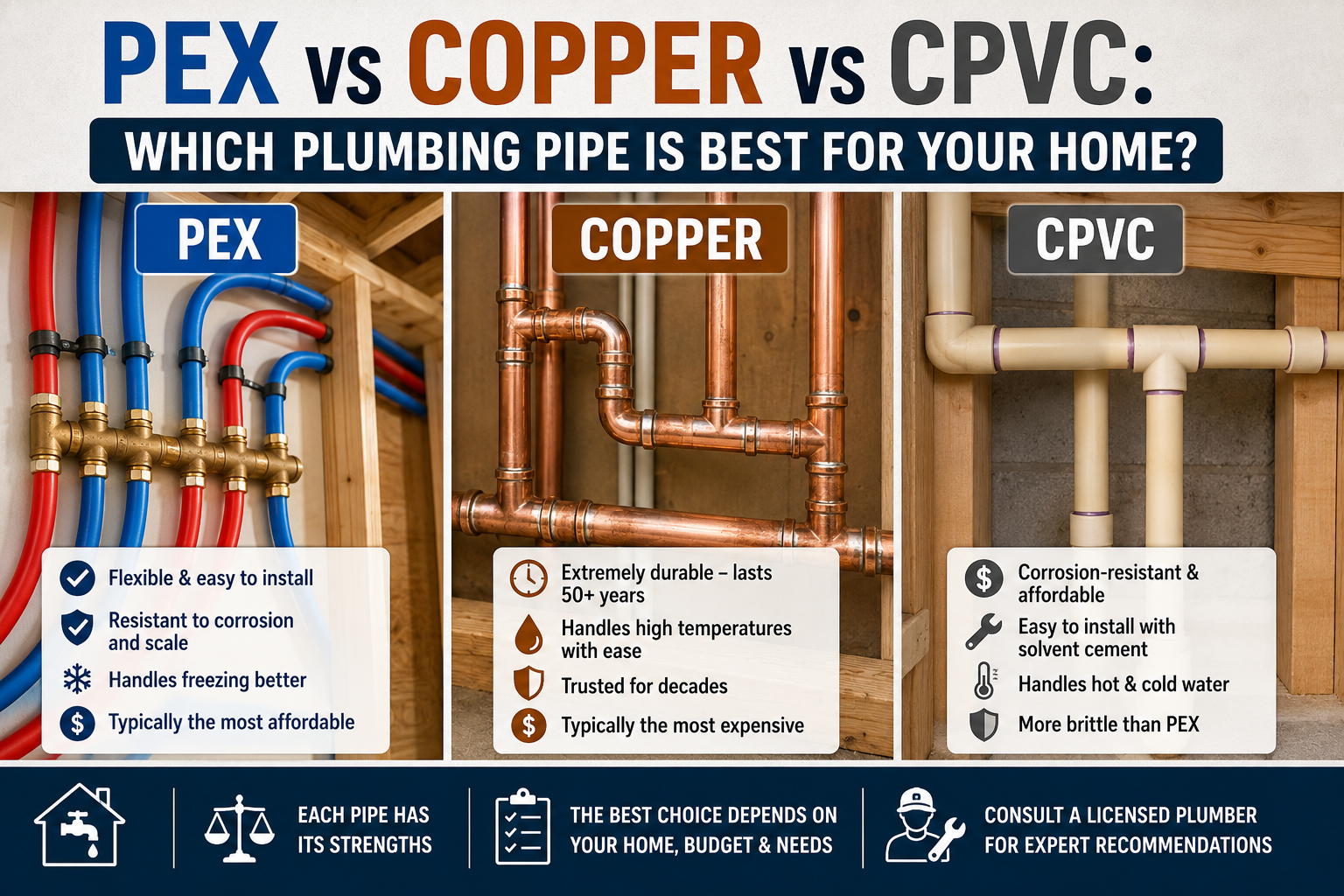
PEX is available in several colors, with red typically used for hot water lines and blue used for cold water lines. White and gray versions are also commonly available.
Today, many new homes throughout the United States are built almost entirely with PEX plumbing.
Advantages of PEX Plumbing
One of the biggest advantages of PEX is its flexibility. Since it bends easily, installation is often faster than with rigid pipe materials.
PEX is also resistant to corrosion and mineral buildup, making it a good choice in areas with hard water.
Another benefit is its ability to tolerate freezing temperatures better than rigid piping. While no plumbing pipe is completely freeze-proof, PEX can expand slightly if water freezes inside, reducing the likelihood of bursting compared to copper or CPVC.
PEX is also quieter than metal pipes because it naturally absorbs vibration, reducing the banging noises sometimes heard in older plumbing systems.
For many homeowners, lower installation costs make PEX an attractive option.
Disadvantages of PEX
Although PEX has many advantages, it is not perfect.
PEX cannot be installed in areas where it will receive prolonged exposure to direct sunlight because ultraviolet rays gradually weaken the material.
It also cannot be used for every outdoor plumbing application.
Some homeowners still prefer traditional metal plumbing because copper has a much longer history of use.
While modern PEX products are extremely reliable, some people simply feel more comfortable with materials that have been used successfully for generations.
What Is Copper Pipe?
Copper has been one of the most trusted plumbing materials for decades.
Many homes built during the second half of the twentieth century still contain original copper plumbing that continues functioning well today.
Copper pipes are rigid metal tubes joined together using soldered fittings. They are available in several thicknesses, with Type L and Type M being the most common for residential plumbing.
Because copper has such a long track record, many homeowners view it as the premium option for water supply piping.
Advantages of Copper Plumbing
Copper offers exceptional durability.
Properly installed copper plumbing can last 50 years or longer under normal conditions.
Unlike plastic piping, copper does not degrade from sunlight, making it suitable for certain exposed applications.
Copper also tolerates high temperatures extremely well, making it an excellent material for hot water distribution.
Many homeowners appreciate the fact that copper has been trusted by plumbers for generations.
It also adds perceived value to some homes because buyers often recognize it as a premium plumbing material.
Disadvantages of Copper
The biggest drawback of copper is cost.
Copper itself is significantly more expensive than PEX or CPVC, and installation requires more labor because every joint must be carefully cut, cleaned, and soldered.
Copper is also susceptible to corrosion under certain water conditions.
Highly acidic water can gradually wear away the inside of copper pipes, eventually leading to pinhole leaks.
Unlike flexible PEX, copper can burst if water freezes inside the pipe.
Because copper is rigid, installation often requires more fittings and more time.
What Is CPVC Pipe?
CPVC stands for chlorinated polyvinyl chloride.
It looks similar to standard PVC pipe but is specially designed to handle hot and cold drinking water.
CPVC has been used in residential plumbing for many years and remains common in certain regions of the country.
Unlike copper, CPVC does not rust or corrode.
The pipe sections are joined together using primer and solvent cement rather than soldering.
Advantages of CPVC Plumbing
One of CPVC’s biggest advantages is affordability.
It generally costs less than copper while still offering good resistance to corrosion.
CPVC is also lightweight and relatively easy to install.
Because it does not rust, it performs well in areas where aggressive water chemistry might shorten the lifespan of metal pipes.
It is capable of handling both hot and cold water under normal residential conditions.
For homeowners seeking a budget-friendly plumbing solution, CPVC can be a practical choice.
Disadvantages of CPVC
CPVC is more brittle than PEX.
Although it performs well under normal conditions, it is more likely to crack if subjected to impact or freezing temperatures.
As homes age, CPVC fittings may become more brittle, especially if exposed to repeated temperature changes.
Because the pipe is rigid, installation typically requires more fittings than flexible PEX systems.
Many plumbers today prefer PEX because it offers greater flexibility and faster installation.
Which Pipe Lasts the Longest?
All three materials can provide decades of reliable service when installed properly.
Copper often lasts 50 years or more.
PEX is expected to provide a similar lifespan under normal residential conditions.
CPVC can also last several decades, although environmental conditions and installation quality play important roles.
In many cases, workmanship has just as much impact on longevity as the pipe material itself.
Proper installation remains one of the most important factors in any plumbing system.
Which Pipe Is Best for Repiping an Older Home?
For complete home repiping projects, many plumbing companies recommend PEX.
Its flexibility allows plumbers to route new water lines through existing walls with less demolition than rigid materials often require.
Fewer fittings also reduce the number of hidden joints behind walls.
Copper remains an excellent option for homeowners who prefer traditional plumbing materials and are willing to invest more upfront.
CPVC is still used successfully in many homes but has become less common for complete repiping projects compared to PEX.
Which Pipe Performs Best in Hard Water?
Hard water contains minerals that gradually build up inside plumbing systems.
Copper pipes can develop mineral deposits over time, reducing water flow.
PEX and CPVC are generally more resistant to mineral buildup because their smooth interior surfaces discourage deposits from sticking.
For homeowners living in areas with hard water, plastic piping often performs well over the long term.
Which Pipe Handles Freezing Temperatures Better?
Although every plumbing system should be protected from freezing temperatures, PEX has an advantage.
Its flexibility allows it to expand slightly if water freezes inside.
Copper and CPVC are much more rigid and therefore more likely to crack or burst when frozen.
Even so, no plumbing material should be relied upon to survive repeated freezing conditions without proper insulation.
Cost Comparison
For many homeowners, budget plays a major role in the decision.
PEX is generally the least expensive option when both materials and labor are considered.
CPVC also offers relatively low material costs, although labor can be slightly higher because it requires additional fittings.
Copper is typically the most expensive option due to both material prices and installation time.
However, many homeowners feel the long lifespan and proven reliability justify the higher investment.
Which Plumbing Pipe Is Best Overall?
There is no single answer that fits every home.
PEX has become the preferred choice for many new construction and repiping projects because it combines affordability, flexibility, durability, and corrosion resistance.
Copper remains an outstanding option for homeowners who value long-term durability and traditional plumbing materials.
CPVC continues to serve as a reliable, cost-effective solution in many residential plumbing systems.
The best choice depends on your home’s specific needs, your budget, local plumbing codes, and your plumber’s recommendations.
Frequently Asked Questions
Is PEX better than copper?
PEX is often less expensive, easier to install, and more resistant to freezing. Copper offers exceptional durability and has been trusted for decades. The best choice depends on your home’s needs and budget.
How long does PEX plumbing last?
Properly installed PEX plumbing is expected to last 50 years or more under normal residential conditions.
Is CPVC still used today?
Yes. CPVC remains an approved plumbing material in many areas and is commonly used for residential hot and cold water supply lines.
Which plumbing pipe is the least expensive?
PEX is usually the most affordable option when both materials and installation costs are considered.
Can copper pipes corrode?
Yes. Certain water conditions, particularly acidic water, can eventually cause copper pipes to develop pinhole leaks.
Which pipe is best for repiping a home?
Many plumbers recommend PEX for whole-home repiping because it is flexible, durable, and requires fewer hidden fittings. However, copper and CPVC may also be appropriate depending on the home’s plumbing system and the homeowner’s preferences.
Choosing the Best Plumbing Pipe for Your Home
Every plumbing system is different, which means there is no one-size-fits-all solution when choosing between PEX, copper, and CPVC. Each material has proven itself in residential plumbing, and each offers unique advantages depending on the home’s age, water quality, budget, and long-term goals. While PEX has become the most popular choice for many modern plumbing projects because of its flexibility, affordability, and ease of installation, copper continues to be valued for its durability and long history of reliable performance. CPVC remains a practical option for homeowners looking for a corrosion-resistant and cost-effective solution.
If you’re planning a whole-home repipe, remodeling your kitchen or bathroom, or replacing aging plumbing, speaking with a licensed plumber is the best way to determine which material fits your home’s specific needs. A professional evaluation can help ensure your new plumbing system provides dependable performance, consistent water pressure, and lasting reliability for many years to come.
What’s Next?
Doug Herrell Plumbing is a trusted leader in Brevard County, Florida, specializing in slab leak detection and re-piping services. Call us today for a free estimate before a slab leak causes unnecessary damage to your property.
About Doug Herrell Plumbing – lic#CFC 048487
Doug Herrell Plumbing has been Brevard County’s source for plumbing services since 1980. We are a family owned and operated business and take tremendous pride in providing honest and reliable plumbing services at an affordable price.
CALL 321-254-0004
Serving Melbourne, Palm Bay, Viera, Suntree, Titusville, Merritt Island, Melbourne Beach, Indialantic, Indian Harbour Beach, Cape Canaveral, Satellite Beach, Rockledge, West Melbourne, Cocoa, and Cocoa Beach.
Table of Contents
- Why Choosing the Right Plumbing Pipe Matters
- What Is PEX Pipe?
- Advantages of PEX Plumbing
- Disadvantages of PEX
- What Is Copper Pipe?
- Advantages of Copper Plumbing
- Disadvantages of Copper
- What Is CPVC Pipe?
- Advantages of CPVC Plumbing
- Disadvantages of CPVC
- Which Pipe Lasts the Longest?
- Which Pipe Is Best for Repiping an Older Home?
- Which Pipe Performs Best in Hard Water?
- Which Pipe Handles Freezing Temperatures Better?
- Cost Comparison
- Which Plumbing Pipe Is Best Overall?
- Frequently Asked Questions
- Choosing the Best Plumbing Pipe for Your Home
- What’s Next?
- Table of Contents